Scaut

Author: danielbutler6045b93171

  • Scaut partners with Trinsic, combining next-generation software platforms to protect Europe against fraud

    Scaut partners with Trinsic, combining next-generation software platforms to protect Europe against fraud

    Stopping identity fraud at the source.

    Today we are proud to announce a partnership between Scaut and Trinsic, the first identity acceptance network and one of the most advanced digital ID platforms in the world. By integrating Trinsic’s identity verification capabilities into the Scaut platform, we are giving our clients a faster, stronger, and more fraud-resistant way to confirm that a subject is exactly who they claim to be –no matter the workflow.


    Why this matters now

    Recruitment fraud is no longer a fringe risk. Synthetic identities, manipulated documents, and AI-generated deepfakes have moved from theory into the recruiter’s inbox. The old approach to identity, asking someone to upload a photo of a plastic ID card and hoping it holds up, was built for a different era. It was never designed to withstand tools that can fabricate a convincing document or face in seconds.

    At Scaut, we have always believed that human resource security is the foundation of organizational trust, especially for the clients we serve in critical infrastructure, financial services, high-tech production and IT firms, as well as the wider enterprise sector across the EU and CEE region. A background check is only as reliable as the identity it is attached to. If you cannot trust the identity, you cannot trust anything that follows.

    That is the gap this partnership closes.


    What Trinsic brings

    Trinsic operates the first identity acceptanc e network, a single API that connects to a world of trusted, government-grade digital IDs. Rather than relying on a photograph of a document, Trinsic lets a person verify themselves using credentials that are already cryptographically trusted, including:

    • Mobile driver’s licences built to the ISO 18013-7 standard
    • European eIDs and the emerging eIDAS and EUDI wallet ecosystem
    • Bank IDs across multiple countries
    • Government and OEM digital wallets, including Apple, Google, and Samsung Wallet
    • Reusable, pre-verified digital identities

    The result is identity verification that Trinsic measures at up to ten times faster, across more than fifty countries, with more than forty ID providers integrated through one connection. Just as importantly, it is built on a security and privacy posture that meets and exceeds industry benchmarks, including SOC 2 Type II and GDPR compliance, along with zero-access encryption that means personal data cannot be read at rest. For a company like ours, operating under GDPR and the tightening expectations of NIS2, CER, and DORA, that is not a nice-to-have. It is the baseline.

    ‍“Trinsic exists to make digital identity acceptance practical for organizations of any scale. By partnering with Scaut, we’re helping organizations streamline identity verification and trust workflows while expanding access to interoperable digital credentials. Together, we’re making it easier for businesses to adopt modern identity solutions without having to build and maintain that infrastructure themselves.” – Riley Hughes, CEO, Trinsic


    What Scaut brings

    Scaut is a sovereign EU compliance platform for pre-employment background screening, business intelligence, and supply chain monitoring, purpose-built for the regulatory reality of Europe and Central Europe. Our screening products are designed for organizations that cannot afford to get a hire wrong, and our roadmap is shaped by a simple conviction: screening should be rigorous, lawful, transparent, and genuinely useful to the people making the decision.

    Bringing Trinsic into the Scaut platform means identity verification is no longer a separate, fragile first step. It becomes a verified anchor for everything that follows, from criminal records and sanctions screening to directorship checks and adverse media.Every downstream result is tied to an identity that has been confirmed against a trusted, government-backed source rather than a picture that may or may not be real.


    What it means for our clients

    For the organizations we work with, the partnership delivers three things atonce:

    1. Stronger fraud resistance. Verifying against trusted digital IDs raises the bar far beyond document photos, directly addressing impersonation and deepfake risk in hiring.
    2. A faster candidate experience. People can verify themselves in seconds using identities they already hold on their phones, reducing drop-off and friction at the start of the screening journey.
    3. Confidence built on compliance. Both companies treat privacy and security as a starting point, not an afterthought, so identity assurance and data protection move in the same direction.

    Two companies looking forward, not back

    We chose Trinsic because we share a worldview. Identity is shifting from physical documents to digital credentials, and the organizations that adopt that shift early will be the ones best protected against the next generation of fraud. Trinsic is building the infrastructure for that future. Scaut is putting it to work where it matters most: deciding who an organization can trust.

    “Hiring fraud is getting more sophisticated, and so are we. Partnering with Trinsic means our clients are no longer verifying identities against a photo of a document. They are verifying against the most trusted digital IDs in the world. That is the standard we believe screening should be held to, and it is where the entire industry is heading. With Scaut being a robust integration friendly platform, we’re always looking out for world class technology to integrate with.” – Petr Moroz, CEO and co-founder, Scaut

    This is the first step in a longer journey to make identity-first screening the norm rather than the exception. We are excited to build it alongside a team that takes digital trust as seriously as we do.

    Want to see verified, fraud-resistant screening in action? Get in touch with the Scaut team to arrange a demo.

  • NIS2 and ZKI: When Background Screening Became a Legal Obligation

    NIS2 and ZKI: When Background Screening Became a Legal Obligation

    For the better part of two decades, background screening in European organisations occupied an ambiguous middle ground. It was widely understood to be good practice. It was recommended in ISO 27001 and various sector-specific codes of conduct. It was common in financial services and aviation, where regulators had long imposed personnel integrity requirements. But for the broad majority of European employers, including those operating critical infrastructure, it was optional.

    That changed with the NIS2 Directive. And in the Czech Republic, it changed again with the updated Zákon o kybernetické bezpečnosti – the national cybersecurity law implementing NIS2 with specific domestic provisions. Background screening has moved, in a relatively short period, from a discretionary HR decision to a legal obligation with enforcement consequences.

    What NIS2 actually requires

    NIS2 – officially Directive (EU) 2022/2555 – entered force in January 2023 and required member state transposition by October 2024. Its scope is broader than its predecessor, NIS1, covering a significantly expanded set of sectors and entities. Essential entities include energy, transport, banking, financial market infrastructure, health, drinking water, wastewater, digital infrastructure, ICT service management, and public administration. Important entities extend to postal services, waste management, manufacturing of critical products, food production, and digital providers.

    The Directive requires entities in these categories to implement appropriate technical and organisational measures to manage cybersecurity risks. Article 21 specifies that these measures must include policies on human resources security, access control, and asset management. Recital 89 makes explicit that human resources security policies should include measures to address the risks posed by employees and contractors.

    This is not ambiguous language. It is a direct statement that personnel security – the systematic assessment of the trustworthiness of people with access to critical systems and data – is a required element of NIS2 compliance. Supervisory authorities in member states are empowered to inspect, require evidence of, and sanction failures in this area.

    The Czech ZKI: a more specific standard

    The Czech Republic’s implementation of NIS2 through the updated cybersecurity act introduces obligations that are, in some respects, more specific than the Directive itself. The ZKI applies to a substantial number of Czech entities, including those operating critical infrastructure under the parallel Critical Infrastructure Act and those identified by the National Cyber and Information Security Agency (NUKIB) as regulated entities.

    Under the ZKI framework, regulated entities must implement personnel security measures that include, among other things, the verification of employee and contractor reliability before granting access to sensitive systems. The law does not prescribe a specific screening methodology, but it is clear that relying on a self-declared CV is insufficient. Entities are expected to demonstrate, in the event of an audit, that they took proportionate steps to verify the backgrounds of those with access to critical systems.

    NUKIB has published guidance indicating that criminal record checks, identity verification, and employment history verification are among the appropriate measures for personnel with privileged access. The deadline for full compliance passed in 2024, meaning that regulated entities that have not yet established screening processes are already in breach.

    Who is affected, and the scale of exposure

    The number of Czech entities subject to ZKI obligations runs into the thousands when critical infrastructure operators, essential service providers, and important entities are counted together. In Germany, the NIS2UmsuCG – the national implementation legislation – imposes similar obligations across an even larger industrial base, given Germany’s scale and its concentration of critical manufacturing, energy, and financial services.

    For Poland, NIS2 transposition has created obligations for entities across the energy, transport, and digital infrastructure sectors, with enforcement authority vested in the national cybersecurity regulator. Across the CEE region as a whole, the combined effect of NIS2 and its national implementations is a significant shift in the legal baseline for personnel security.

    The enforcement consequences are substantial. NIS2 mandates minimum fines for essential entities of at least 10 million euros or 2% of global annual turnover, whichever is higher. For important entities, the minimum is 7 million euros or 1.4% of turnover. These are not symbolic penalties. They are calibrated to be financially meaningful even for large organisations.

    The gap between obligation and practice

    Despite the clarity of the obligation and the scale of the consequences, many European organisations subject to NIS2 have not yet implemented systematic screening processes. The reasons vary. Some organisations are in the process of mapping their compliance obligations and have not yet reached the personnel security workstream. Others have concluded, incorrectly, that their existing pre-employment reference checking satisfies the requirement. Others still are waiting to see whether enforcement authorities prioritise this area.

    The experience from GDPR enforcement offers a relevant parallel. When GDPR came into force in 2018, many organisations adopted a wait-and-see approach, betting that enforcement would be slow and that procedural compliance was sufficient to avoid sanction. Enforcement was initially slow. But it accelerated. The fines issued since 2020 have been substantial, and the pattern of enforcement has followed a clear trajectory: early action against the most visible failures, followed by increasingly systematic scrutiny of organisational practices.

    NIS2 enforcement is following a similar pattern. NUKIB and its counterparts in Germany and Poland have begun supervisory inspections of regulated entities, and personnel security practices are within scope.

    What a compliant screening programme looks like

    A compliant personnel security programme under NIS2 and ZKI does not need to be elaborate. It needs to be proportionate, documented, and consistently applied.

    For employees and contractors with access to sensitive systems or data, the minimum defensible standard includes identity verification, criminal record checks appropriate to the individual’s country of residence and nationality, and verification of the employment or engagement history they have represented to the organisation. For roles with privileged access – system administrators, security personnel, those with access to personal data at scale – enhanced checks including adverse media screening and, where relevant, financial probity checks are appropriate.

    Critically, the programme must be documented. An organisation that has conducted screening but cannot demonstrate what it did, when, and for whom, is in a weak position relative to a regulator seeking evidence of compliance. The screening process should generate records that can be produced on request.

    Finally, the programme must extend to contractors, temporary staff, and agency workers, not just permanent employees. NIS2 and ZKI do not distinguish by employment type. If an individual has access to regulated systems, they should be within scope of your screening programme regardless of how they are engaged.

    The window for proactive compliance

    Organisations that have not yet implemented structured screening can still approach this proactively rather than reactively. Establishing a screening programme now, with clear documentation of what is covered, at what standard, and how results are recorded and acted upon, creates a defensible position against regulatory scrutiny.

    The alternative – waiting until an inspection reveals a gap – is a significantly less attractive option. Supervisory authorities are not only empowered to impose fines: they can require remediation within tight timeframes, impose operational restrictions, and publicise enforcement actions in ways that create reputational as well as financial consequences.

    Background screening is no longer a nice-to-have. In regulated sectors across Europe, it is the law.

  • The Contractor in Your Network: Why Third-Party IT Risk Starts with the Person, Not the Software

    The Contractor in Your Network: Why Third-Party IT Risk Starts with the Person, Not the Software

    In May 2021, a Serbian cryptocurrency company hired a developer named “Bryan Cho” — a stolen identity used by Jong Pong Ju, a North Korean state operative. He passed the company’s hiring checks because those checks confirmed the name was clean, not that the person was real. Once inside with trusted developer access, he and his co-conspirators stole $915,000 in cryptocurrency directly from the company’s holdings, laundering it through mixers and shell accounts before the fraud was uncovered — not by the company, but by a US federal grand jury indictment four years later in June 2025. A background check that verified the authenticity of the identity document and confirmed the person presenting it matched that document biometrically would have rejected the application before the operative ever gained access. The Serbian case is one data point in a pattern that CrowdStrike now tracks across the UK, Poland, Romania, and other European countries, with infiltrations of this kind growing 220% in the past twelve months alone.

    The cost of the check that was not done: a fraction of a percent of $915,000.

    The scale of third-party IT dependency

    European organisations have never been more reliant on external IT talent. The Eurostat ICT workforce survey consistently shows that the majority of medium and large enterprises outsource at least a portion of their IT function, whether through managed service providers, nearshore development teams, IT staffing agencies, or independent contractors. In the Czech Republic, Germany, and Poland – three of the fastest-growing technology markets in the CEE region – IT outsourcing accounts for a significant share of total IT spending.

    This dependency creates a structural risk that most organisations systematically underestimate. A contractor does not appear on a company’s HRIS. They are often onboarded through procurement rather than HR. Their access credentials are frequently provisioned at short notice. Their right-to-work and identity is verified, if at all, by the agency or intermediary that placed them – not by the organisation whose network they are entering.

    IBM’s Cost of a Data Breach Report 2023 found that breaches involving third parties cost an average of 11.8% more than those originating internally, and took significantly longer to detect. The Ponemon Institute has separately reported that 51% of organisations have experienced a data breach caused by a third party. In Europe, where GDPR fines for insufficiently secured personal data can reach 4% of global annual turnover, the financial exposure is amplified considerably.

    Who are these contractors, exactly?

    The IT contractor population is diverse, and so is the risk profile. At the lower end of the risk spectrum sits the web developer brought in for a three-month project, who is given access to a staging environment and a Slack workspace. At the higher end sits the infrastructure engineer who has been granted administrator-level access to production servers, cloud environments, or financial systems – and who may be working simultaneously for several other clients.

    Between these poles lies a large population of IT professionals whose access is significant and whose vetting is minimal. Database administrators, DevOps engineers, network technicians, support desk staff, and software developers working under staff augmentation contracts frequently hold access to systems that would, if compromised, constitute a serious regulatory and reputational event.

    The 2023 breach at a major German logistics company, attributed to a contractor account that had not been deprovisioned following the end of an engagement, illustrates the operational reality. Access had been granted. The work had concluded. The account remained active. The attacker who eventually discovered and exploited it did not need to be sophisticated – they simply needed to find an open door.

    What NIS2 and ZKI require

    The NIS2 Directive, which entered transposition across EU member states from October 2024, places explicit supply chain security obligations on operators of essential and important entities. Article 21 requires organisations to implement measures that address the security of supply chains, including the security practices of direct suppliers and service providers. This is not limited to software and hardware – it extends to the human elements of those supply chains.

    In the Czech Republic specifically, the Zákon o kybernetické bezpečnosti – the national cybersecurity act implementing NIS2 – imposes personnel security requirements on regulated entities that include obligations to assess the trustworthiness of individuals with access to critical systems. This is a meaningful legal development. It shifts background screening from a discretionary HR practice to a regulated security obligation.

    For organisations that rely on external IT contractors, compliance with these requirements demands a structured approach to pre-engagement vetting that mirrors, at minimum, the standard applied to permanent employees in equivalent roles.

    What does effective contractor screening look like?

    Effective screening for IT contractors should be proportional to access level. An individual with read-only access to a test environment is not the same risk as someone with write access to a production database or administrator access to a cloud environment. The screening regime should reflect this.

    At a minimum, contractors being granted access to sensitive systems should be subject to identity verification, criminal record checks covering their country of residence and, where relevant, prior countries of residence, and verification of the employment history they have presented. Reference checks from prior engagements should be obtained. Where contractors are nationals of, or have lived in, countries that present particular geopolitical risk, enhanced due diligence is warranted.

    In practice, most European organisations do none of this for contractors. They rely on the placing agency to have conducted some level of check, without verifying what standard was applied, whether checks were recent, or whether the individual being placed is actually the individual who was screened. This is a significant gap.

    The challenge of multi-tier supply chains

    A further complication is the prevalence of subcontracting within IT service delivery. A managed service provider contracted by your organisation may itself subcontract specialist work to a boutique firm, which may in turn use freelancers sourced from platform marketplaces. By the time an individual arrives at your systems, they may be three or four degrees removed from any entity that has a direct contractual relationship with you.

    European organisations operating in regulated sectors – financial services, energy, healthcare, telecommunications – should be establishing contractual requirements that flow down through supply chains. These should specify minimum screening standards, require evidence of compliance, and reserve the right to audit or request screening documentation for any individual granted access to systems or data.

    The practical steps organisations can take now

    The starting point is an audit of who currently has access to your systems and on what basis. Many organisations discover, when they conduct this exercise, that they have active access credentials belonging to contractors who left months or years previously, or that access rights were never scoped appropriately to the work being performed.

    From there, the implementation of a structured pre-engagement screening process for all contractors being granted system access is a proportionate and defensible response to both the threat environment and the regulatory requirements. This does not need to be burdensome. Modern background screening platforms can deliver results for European contractors within 24 to 72 hours in most cases, covering the checks that matter.

    Finally, organisations should establish a clear deprovisioning process, triggered automatically at the end of any contractor engagement, that removes or suspends access credentials. The number of major incidents that can be traced to dormant accounts is striking, and the remedy is straightforward.

    The contractor in your network may be entirely trustworthy. But without a structured process for establishing that trust, you are extending access on the basis of assumption alone. In 2025, that is no longer a defensible position – legally, operationally, or commercially.

  • The Identity You Trust May Not Be the Identity You Think: Cross-Border Credential Fraud in the European Hiring Market

    The Identity You Trust May Not Be the Identity You Think: Cross-Border Credential Fraud in the European Hiring Market

    From Romanian passports sold to sanctioned Russians, to North Korean operatives applying for developer roles in Germany with fabricated Serbian degrees – the cross-border hiring process has become an active threat surface. Here is what the evidence says European employers must do differently.

    In December 2025, Le Monde published the findings of an investigation that should have sent a chill through every HR and compliance team across the European Union. A small commune in northern Romania called Varfu Campului, population officially around 3,400, had somehow registered more than 10,000 residents. Those residents – citizens of Russia, Moldova, and Ukraine – had been issued Romanian identity documents using fictitious addresses, sometimes without the knowledge of the property owners whose addresses were used. Civil registry officials had processed the applications in exchange for bribes. A criminal network had, in effect, manufactured European Union identities at industrial scale.

    Some of the Russian applicants had used the identities of Ukrainian soldiers killed on the front line to support their citizenship claims. Romanian passports were being sold on social media channels targeting Russian speakers for between 4,000 and 7,500 euros, with prosecutors noting one client paid 75,000 euros to an intermediary for a fraudulently obtained citizenship certificate. By the time Romanian authorities began systematic enforcement, more than 18,700 people from former Soviet republics had registered fictitious residences in the country. Hundreds had already received Romanian passports – and with them, the right to live and work freely anywhere in the European Union.

    The direct employment implication is straightforward and serious. An employer in Prague, Warsaw, or Munich who hires a worker presenting a Romanian passport has no reason, from a document authenticity perspective, to treat that document differently from one issued by the Czech or German state. Romanian citizenship is EU citizenship. Yet a subset of Romanian passports now in circulation are fraudulently obtained, issued through a corrupted administrative process, and may belong to individuals – including Russian nationals evading sanctions – whose true identity and background would disqualify them from employment in regulated environments. An employer who accepts the document at face value has completed a right-to-work check. They have not verified who the person actually is.


    The systematic targeting of European hiring pipelines

    The Romanian passport case illustrates one dimension of the cross-border identity verification challenge: the fraudulent acquisition of apparently legitimate EU documents. A separate and equally well-documented challenge involves the systematic fabrication of entire professional identities for use in European employment applications.

    In April 2025, Google’s Threat Intelligence Group (GTIG) published findings documenting a significant escalation in North Korean state actors targeting European companies for fraudulent IT employment. Investigators found fabricated personas with resumes listing degrees from Belgrade University in Serbia, claimed residences in Slovakia, and specific operational guidance for navigating European job sites – including instructions to use a Serbian time zone during communications to avoid detection. North Korean operatives were seeking work through Upwork, Telegram, and Freelancer, with facilitators in the UK and US helping to manage company-issued laptops and receive salary payments on their behalf.

    Germany and Portugal were specifically identified as primary European targets. The scheme involved not only fabricated qualifications and work histories but also stolen identity documents from real people in Italy, Japan, Malaysia, Singapore, Ukraine, and Vietnam – giving the fraudulent personas a paper trail that appeared to reference genuine individuals who could be found online. Rafe Pilling of Secureworks described the threat plainly: hiring practices are not something most people think about in terms of cybersecurity, but they should be.

    ESET Research’s findings, published in September 2025, added further granularity. Their analysis of the DeceptiveDevelopment group – a North Korean-aligned operation active since at least 2023 – documented specific targeting of developers in France, Poland, and Ukraine. The group used fake job interview processes and social engineering techniques to deliver malware and steal cryptocurrency, with the fraudulent employment pipeline serving as the access mechanism. CrowdStrike has reported investigating at least one European incident per day involving these operations.


    Why CEE employers are structurally exposed

    Central and Eastern European employers sit at the intersection of several overlapping vulnerabilities that make them particularly exposed to cross-border credential fraud.

    The first is the scale and speed of cross-border labour dependency. Eurostat data for 2022 and 2023 shows the Czech Republic received among the highest levels of net migration relative to population of any EU member state, driven by Ukrainian displacement and sustained economic migration from Central Asian countries. The International Labour Organization has estimated that approximately 1 in 4 workers in certain Czech manufacturing and logistics sub-sectors is of non-EU origin. Poland and Germany have experienced comparable dynamics. At this volume, hiring processes that were designed for a relatively homogeneous domestic labour market are being applied to an internationally diverse candidate pool for which they are structurally inadequate.

    The second vulnerability is document trust. The Romanian passport fraud case demonstrates that EU identity documents are not a reliable proxy for verified identity. A document that looks genuine, was issued by a legitimate EU state authority, and passes a visual inspection may nonetheless have been obtained through a fraudulent process. The employer who relies on document presentation as their verification method is operating on a false assumption of security.

    The third vulnerability is the gap between IT hiring and security awareness. The specific targeting of European IT roles – developers, cloud engineers, DevOps professionals – by North Korean and other state-linked actors exploits a structural gap between HR hiring processes and the security sensitivity of the roles being filled. A developer with privileged access to production systems is a high-value target. The hiring manager filling that role is typically focused on technical skills, not counterintelligence.


    What makes cross-border verification genuinely difficult

    The verification challenges are specific and layered, and it is worth being precise about each rather than treating them as a single undifferentiated problem.

    Identity document authentication goes well beyond visual inspection. The Romanian passport fraud demonstrates that even government-issued EU documents can be fraudulently obtained through corrupted administrative processes. Effective authentication requires technical verification against known document standards, biometric matching between the document and the individual presenting it, and – for candidates from higher-risk originating countries – awareness of the specific fraud typologies documented in that jurisdiction.

    Criminal record verification is operationally complex for non-EU nationals. Czech criminal record checks through ISKN operate efficiently for Czech nationals. For a Ukrainian or Kazakh national, obtaining a formal criminal record certificate requires engagement with the relevant national authorities, apostille certification, and translation – a process that most employers simply skip, defaulting to a self-declared statement that carries no evidential value.

    Employment history verification must involve independent contact with prior employers through channels that are not provided by the candidate. In the Warsaw case documented in the Scaut Threat Intelligence Report, the developer’s claimed employment at Estonian and Lithuanian banks was never independently verified. The employers were never contacted. The fraud that followed cost the firm 840,000 euros and eight months of undetected data exfiltration. A verification process that calls numbers the candidate themselves supplied is not verification – it is confirmation of the narrative they want you to accept.

    Sanctions and watchlist screening must be applied consistently across nationalities and conducted in the worker’s native language. An adverse media search conducted only in English will not reliably surface entries in Ukrainian, Russian, Kazakh, or other relevant language sources. For employers in regulated sectors with NIS2 obligations, the inconsistent application of sanctions screening across the workforce is both a security gap and a compliance failure.


    The regulatory environment is tightening from multiple directions

    European employers face a converging set of regulatory obligations that are raising the standard for what constitutes adequate cross-border workforce verification.

    NIS2 and the Czech ZKI impose personnel security requirements on regulated entities that do not distinguish by nationality or employment type. A Ukrainian IT contractor with access to critical systems carries the same screening obligation as a Czech national in an equivalent role. The legal standard does not have a carve-out for workers whose background is harder to check.

    The EU Corporate Sustainability Due Diligence Directive (CSDDD), entering progressive force from 2026, will require companies to conduct due diligence on labour conditions and practices across their supply chains. For employers using staffing agencies to source foreign workers, this creates obligations that extend to the credibility of the vetting applied by those agencies.

    The Employment of Foreigners Act in the Czech Republic requires employers to retain copies of identity documents and work permits for third-country nationals. This is a documentation requirement that many employers fulfil without any meaningful verification of the documents being retained – filing a potentially fraudulent document with administrative efficiency while creating a false sense of compliance.


    What proportionate verification looks like in practice

    The cases reviewed here – the Warsaw financial services fraud, the Romanian passport network, the North Korean IT worker campaigns targeting Germany, Poland, and France – share a common characteristic. The fraud succeeded not because it was undetectable, but because the detection was not attempted, or was applied at an inadequate standard.

    Effective cross-border verification requires document authentication that goes beyond visual inspection: technical verification of security features against known standards for the issuing country, biometric matching between document and individual, and awareness of the specific fraud typologies relevant to each originating jurisdiction. The Romanian passport case in particular means that EU citizenship documents from certain issuing contexts should no longer be treated as inherently reliable.

    Employment history verification must involve independent contact with prior employers through channels researched independently, not provided by the candidate. For employers in Estonia, Lithuania, Ukraine, or Central Asia, this requires language capability and in-country partner access. This is a specialist resource, but it is the difference between confirmation and verification.

    Criminal record verification for non-EU nationals requires structured engagement with the relevant authorities in the originating country – either through direct request processes or through specialist partners with established access. The shortcut of accepting a self-declaration is not a proportionate response to the documented risk.

    Sanctions and adverse media screening must be applied consistently across the full workforce, regardless of nationality, and conducted in the candidate’s native language. The convergence of state-sponsored employment fraud, sanctions evasion through document manipulation, and the industrial-scale falsification of professional credentials means that the cross-border hiring process is now an active threat surface. The employers who recognise this and build their verification processes accordingly will be better protected. Those who continue to rely on a document check and a reference call to a number the candidate provided are leaving a door open that motivated bad actors already know how to walk through.

  • The Weakest Link: How Unscreened Supplier Workforces Are Compromising Supply Chains (and what procurement leaders need to do about it)

    The Weakest Link: How Unscreened Supplier Workforces Are Compromising Supply Chains (and what procurement leaders need to do about it)

    Your employees are vetted. Your access controls are tight. But what about the thousands of people your suppliers send through your gates every day? The cleaner who badges into your semiconductor fab at 5 a.m. The logistics driver who enters your defense compound every Tuesday. The IT contractor who has remote access to your production systems. Are they screened to the same standard as your own people?

    For most organizations, the honest answer is: we don’t know.

    That gap between the rigorous screening applied to direct employees and the near-total absence of screening applied to supplier personnel is one of the most underestimated risks in modern supply chain management. Across industries from automotive to defense, from semiconductors to freight forwarding, the people who move through supply chains are increasingly the vectors through which theft, espionage, sabotage, and regulatory failure enter an organization.

    This article examines why supplier workforce screening has remained a blind spot, what happens when that blind spot is exploited, and what the emerging regulatory landscape – particularly in the Czech Republic and the EU – now demands. It also sets out a practical framework for procurement leaders who want to close this gap before it becomes a crisis.

    The Screening Gap: Why Your Suppliers’ People Are Your Problem

    Most large organizations have well-established processes for screening their own employees. Pre-employment background checks – criminal records, identity verification, sanctions screening – are standard practice in regulated industries. The logic is straightforward: if someone will have access to your premises, data, or critical systems, you need to know who they are and whether they present a risk.

    But the moment that same access is granted to a supplier’s employee, the logic breaks down. Procurement contracts may specify service levels, delivery timelines, and pricing. They almost never specify that every individual the supplier deploys must be screened to a defined standard – and even where they do, verification is rare.

    The result is a two-tier workforce operating within the same security perimeter. Direct employees are screened. Supplier employees are trusted by proxy – trusted because the contract exists, because the supplier “must have” checked their people, because nobody has ever asked. This is not an oversight in any individual contract. It is a systemic failure in how procurement relationships are structured.

    Consider the scale: in many manufacturing, logistics, and infrastructure environments, contractor and supplier personnel outnumber direct employees by two or three to one. In some semiconductor fabrication facilities, the ratio is even higher. Each of those individuals represents an access point that has never been independently verified.

    The procurement function sits at the center of this problem – and therefore at the center of the solution. Procurement teams select suppliers, negotiate contracts, manage relationships, and oversee performance. They are uniquely positioned to require, verify, and enforce workforce screening standards across the supply chain. But to do that, they need to understand the risk, the regulatory direction, and the tools available.

    When the Weakest Link Breaks: Real-World Cases

    The consequences of failing to screen supplier workforces are not hypothetical.


    Target’s $300M Data Breach (2013)

    The Target breach (in which 70 million customers’ data was compromised) remains the defining case of third-party supply chain risk. The attackers didn’t break through Target’s firewall. They stole credentials from Fazio Mechanical Services, a small HVAC contractor with access to Target’s vendor portal. Fazio’s employees had never been subjected to meaningful background screening by Target, and Fazio’s own security practices were minimal. The attackers used those credentials to move laterally through Target’s network, eventually installing malware on point-of-sale systems across nearly 1,800 stores.

    The total cost exceeded $300 million in settlements, legal fees, remediation, and reputational damage. The CEO and CIO both lost their jobs. Target’s stock price dropped significantly and consumer trust took years to rebuild. The root cause was not a sophisticated zero-day exploit – it was an unscreened individual at a supplier with access to a critical system.

    Notably, Fazio was not a large strategic supplier. It was a small regional contractor – exactly the kind that falls below the threshold of scrutiny. This is the paradox of third-party risk: the smallest, least-visible suppliers often present the largest access risks, precisely because they escape the due diligence applied to major partners.


    North Korean IT Worker Infiltration (2020–Present)

    Perhaps the most striking contemporary example is the systematic infiltration of Western companies by North Korean IT workers using false identities. Documented extensively by the FBI and U.S. Department of Justice, this scheme involves thousands of operatives obtaining remote contractor positions through staffing agencies, freelance platforms, and subcontractor arrangements – exactly the relationships procurement teams manage.

    Revenue (estimated in the hundreds of millions of dollars) funds North Korean weapons programs. In several documented cases, infiltrators also exfiltrated proprietary code, intellectual property, and sensitive internal data. Companies ranging from Fortune 500 technology firms to mid-market European businesses have been identified as victims.

    What makes this scheme particularly relevant to procurement is the mechanism. These aren’t hackers breaking through firewalls. They’re people engaged through legitimate commercial channels who passed interviews but never passed an identity check. They invoice through established payment channels. They deliver work. The only thing they haven’t done is prove they are who they claim to be.

    If a hostile state can place thousands of operatives into Western supply chains by exploiting the screening gap, the gap is not a minor oversight — it is a strategic vulnerability. The response from governments has been to push responsibility to the companies that engage these workers – and by extension, to the procurement teams that manage those supplier relationships.


    GE Aviation Trade Secret Theft (2019)

    An engineer at GE Aviation was convicted of conspiring to steal jet engine turbine technology, sending proprietary data to collaborators in China. The investigation revealed that sensitive IP flowed through a network of suppliers with vastly different screening standards. GE’s supply chain spans hundreds of companies, each employing specialists with varying access to proprietary data. The screening practices at these suppliers ranged from rigorous to non-existent — and GE had limited visibility into which was which.


    UK Food Supply Chain Contamination (2008–2020)

    Over two decades, temporary agency workers with undisclosed criminal histories were repeatedly placed in food handling roles by staffing agencies conducting no background checks. In one 2008 incident, a contractor employee at a meat processing plant (with a prior conviction that had never been checked) was involved in deliberate product contamination costing an estimated £12 million in recalls.


    ASCO Industries Ransomware Shutdown (2019)

    ASCO, a Belgian aerospace supplier to Airbus, Boeing, and Lockheed Martin, was hit by ransomware that shut production across four countries for weeks. The breach was consistent with compromised credentials – the kind of access contractor personnel routinely hold. Over 1,000 employees were sent home.


    The Common Thread

    Every case follows the same pattern: an individual in the supply chain who was never properly vetted. The damage ranges from millions in financial losses to national security compromise. And for every incident that becomes public, security professionals estimate many more go undetected.

    Why Supplier Screening Falls Through the Cracks

    If the risk is so clear, why do most procurement teams still not address it?


    The contractual illusion.
    Most contracts include broad clauses requiring suppliers to “maintain appropriate security measures.” In practice, these are almost never enforced or audited. A supplier can sign a contract promising screened personnel, then subcontract to a staffing agency that conducts no checks. The procuring organization has a piece of paper. It does not have assurance.


    The cost perception.
    Adding screening requirements is perceived as adding cost. This is almost always wrong. A comprehensive background check costs €20–€80 per individual. A single supply chain compromise routinely costs millions. The return on investment is not marginal – it is overwhelming.


    The jurisdictional complexity.
    Cross-border screening means navigating different legal frameworks, data sources, and privacy regulations. A Czech company with German suppliers, Polish assembly, and Slovak distribution faces four legal environments. This complexity is real, but modern screening platforms are designed to handle it through a single interface – which is precisely what Scaut was built to do.


    The reputational blind spot.
    When a supply chain incident becomes public, the headline names your brand, not the subcontractor. A company’s reputation is effectively held by the weakest screening practices in its supply chain.


    The organizational silo.
    HR screens direct employees. Security manages facility access. Procurement owns the supplier relationship but not the personnel question. Nobody is systematically asking: are the supplier’s people screened? Breaking this silo requires procurement to become the enforcement mechanism – the function that builds screening into contracts and verifies compliance.

    The Regulatory Tipping Point: “Should” Is Becoming “Must”


    Czech Critical Infrastructure Act (ZKI)

    The 2025 Act on Critical Infrastructure requires critical entities and their suppliers to verify the reliability of all personnel with access to critical assets – identity verification and criminal record checks as a minimum. By March 1, 2026, all personnel of critical suppliers must be verified, with fines up to CZK 50 million for non-compliance. Regulators have the power to audit compliance and require evidence of screening processes.

    The practical implications are substantial. Procurement teams must identify every supplier whose personnel access critical assets, define screening requirements, embed them in contracts, and verify compliance on an ongoing basis. For organizations with hundreds of active suppliers, this is an operational challenge that manual processes simply cannot address within the available timeframe.

    The ZKI also introduces the concept of “critical suppliers” – those whose disruption or compromise would materially affect the operation of the critical entity. These suppliers face heightened obligations, including demonstrating their own screening practices to the critical entity and to regulators. Procurement teams are the natural enforcement point for this requirement.


    EU NIS2 and CER Directives

    NIS2 explicitly requires essential entities to address supply chain security, including relationships with direct suppliers. Article 21 is unambiguous: organizations must address “security-related aspects concerning the relationships between each entity and its direct suppliers or service providers.” National implementations across the EU are interpreting this as requiring workforce-level verification. The parallel CER Directive requires background checks on personnel in sensitive roles (explicitly including personnel performing functions on behalf of third parties).

    Together, these create a comprehensive regulatory framework where workforce screening is not a recommendation but a legal requirement. Fines under NIS2 reach €10 million or 2% of global turnover for essential entities. These are not theoretical maximums – regulators across the EU have signaled clearly that enforcement will be active and that supply chain failures will be treated as organizational failures.

    The regulatory direction across Europe is unmistakable: if people are in your supply chain, you must know who they are. The era of voluntary best practice is giving way to mandatory compliance, and procurement teams are on the front line of that transition.

    The Hidden Costs of Doing Nothing

    Beyond regulatory fines, the costs are cumulative and often hidden. Cargo theft in Europe exceeds €8.2 billion annually (TAPA, 2022), with a significant proportion involving insider knowledge from supply chain personnel. IP theft costs European industry an estimated €60 billion per year (European Commission). Civil liability for breaches caused by unscreened supplier personnel can be devastating – Target’s costs exceeded $300 million for a single incident.

    Operational disruption adds another layer. When a supply chain compromise occurs, the immediate impact is severe: production stoppages, facility lockdowns, IT shutdowns, and emergency audits consume management time, disrupt delivery schedules, and damage customer relationships. The ASCO Industries attack halted production across four countries for weeks – all traceable to compromised access credentials.

    Some organizations, confronted with the need for supplier screening, begin exploring internal solutions – patching together criminal record providers across jurisdictions, building manual identity verification workflows, creating spreadsheet-based compliance tracking. This approach almost always fails. The jurisdictional complexity of cross-border screening requires specialist knowledge of data sources, legal frameworks, and privacy regulations in each country. The technology infrastructure – API integrations with criminal record databases, identity verification systems, sanctions lists – takes years and millions of euros to build. And the regulatory landscape evolves continuously, requiring constant updates to remain compliant.

    Purpose-built screening platforms exist precisely because this problem is too complex and too specialized for most organizations to solve alone. The economics are clear: a platform that costs a fraction of a single compliance failure is not an expense – it is insurance with a guaranteed return.

    Building a Supplier Screening Program: A Practical Framework


    Step 1: Map your risk surface.
    Identify which suppliers have personnel accessing your premises, systems, or data. This is not limited to large strategic suppliers – it includes cleaning companies, maintenance contractors, IT providers, logistics operators, catering firms, and staffing agencies. In many organizations, the highest-risk access points are held by the smallest, least-visible suppliers. Create a risk-tiered classification: critical access (physical entry to secure areas, access to critical systems), elevated access (regular on-site presence), and standard access (occasional, limited presence). Screening requirements should be calibrated to each tier.


    Step 2: Define your screening standard.
    For critical access: identity verification, criminal records (domestic and international where relevant), sanctions and watchlist screening, and financial integrity checks for fiduciary roles. For elevated access: identity verification and criminal records. For standard access: identity verification. Document this clearly – it becomes the contractual baseline for every supplier and the standard against which compliance will be measured.


    Step 3: Embed screening in procurement contracts.
    Broad clauses like “supplier shall comply with all applicable laws” are unenforceable in practice. Be specific: which checks are required for each access tier, the obligation to screen all personnel before granting access, the right to audit compliance and request evidence, the consequences of non-compliance including contract termination, and the requirement to notify of any material changes. This is not boilerplate – it is an enforceable obligation that shifts responsibility from assumption to verification.


    Step 4: Automate.
    Manual processes don’t scale. If you have 200 suppliers deploying 5,000 people across three countries, spreadsheets and email chains won’t cut it. You need a platform that automates the entire workflow – from inviting supplier personnel to complete checks, through identity verification and criminal record screening across jurisdictions, to real-time compliance dashboards and audit-ready reporting. This is the core of what Scaut provides: automated screening across the Czech Republic and 30+ European jurisdictions through a single interface, so procurement teams can manage supplier compliance at scale without creating bottlenecks.


    Step 5: Monitor continuously.
    Screening is not a one-time event. Criminal records update. Sanctions lists evolve. People’s circumstances change. A supplier employee who was clean at the point of hire may present a different risk profile two years later. Implement re-screening at defined intervals and real-time alerts for changes in sanctions or adverse media status. Use the data to refine your risk tiers and improve supplier selection over time.

    Industry Perspectives


    Automotive.
    Supply chains spanning hundreds of suppliers across dozens of countries. The shift to EVs and autonomous driving introduces sensitive battery chemistry, sensor calibration, and AI training data flowing through networks with limited visibility into who is handling them. The Volkswagen Dieselgate case demonstrated that fraud can persist across multi-tier supply chains for years. Supplier qualification frameworks like IATF 16949 are beginning to incorporate personnel security expectations – screening evidence will become a standard audit element within the next two to three years. Tier-1 suppliers that cannot demonstrate screening capabilities risk losing contracts to competitors who can.


    Defense and Aerospace.
    Governments across Europe are tightening personnel vetting for anyone accessing defense programs, including subcontractor personnel at every tier. The GE Aviation case and broader trends of state-sponsored economic espionage have driven defense primes to impose detailed screening requirements on their supply chains. Suppliers who cannot demonstrate compliant processes face disqualification from programs, loss of security clearances, and exclusion from bid lists.


    Freight and Logistics.
    Personnel have physical access to goods in transit with minimal direct supervision. The TAPA cargo theft figures – €8.2 billion annually in Europe – reflect a reality in which supply chain insiders are frequently the enablers of loss. Clients increasingly require evidence of workforce screening as a condition of awarding contracts, particularly for high-value, pharmaceutical, and defense-related cargo. For logistics procurement teams, screening is not just about compliance – it is about commercial survival.


    Semiconductors and High-Tech.
    Fab access means access to technology worth billions in R&D investment, process secrets that define competitive advantage, and equipment subject to export controls. Contractor personnel – maintenance technicians, calibration specialists, cleanroom staff – often spend more time inside fabs than the chipmaker’s own engineers. Governments are increasingly linking public funding, including EU Chips Act subsidies, to evidence of supply chain security measures. Procurement teams that cannot demonstrate workforce screening across their supplier base may find themselves ineligible for the funding designed to support their competitiveness.

    The Path Forward

    Supplier workforce screening is transitioning from an afterthought to a strategic imperative. Organizations that act now gain regulatory readiness before deadlines hit, supply chain resilience through knowing who is actually in their ecosystem, and competitive differentiation in procurement markets where screening is becoming a contract requirement.

    Every week of delay is a week in which unscreened individuals continue to access your sites, systems, and sensitive assets. It is a week closer to regulatory deadlines that will not be extended. And it is a week in which competitors who have already started are building the compliance infrastructure that makes them preferred partners.

    The gap between screening your own people and screening your suppliers’ people is the most significant unaddressed risk in most supply chains today. It is also the most addressable. The technology exists. The regulatory framework is arriving. The cost of inaction is rising.

    The choice – and the responsibility – sits squarely with procurement.

  • 7 Reasons Why Your Background Screening Process Might Be Costing You Top Talent

    7 Reasons Why Your Background Screening Process Might Be Costing You Top Talent

    Research shows that 35% of candidates abandon hiring processes when background checks take longer than two weeks. In competitive European markets, screening delays aren’t just inconvenient—they’re expensive. Here’s what to watch for:

    :alarm_clock:

    Weeks-Long Criminal Check Timelines

    If power of attorney paperwork is adding 4-6 weeks to your EU criminal background checks, you’re likely losing qualified candidates to faster-moving competitors. New approaches now exist that can complete multi-country checks without traditional POA requirements.

    :memo:

    Excessive Candidate Paperwork

    Every additional form or document request reduces completion rates by 10-15%. When candidates face separate submissions for identity verification, criminal checks, and employment history, friction compounds and dropout increases.

    :mobile_phone:

    Desktop-Only Submission Requirements

    Over 60% of candidates prefer completing screening tasks on mobile devices. Processes that require desktop access for document uploads create unnecessary barriers—especially for younger talent pools.

    :earth_africa:

    No Solution for Multi-Country Roles

    European businesses routinely hire across borders, yet many screening processes treat each jurisdiction as a separate, manual workstream. Modern platforms should offer unified multi-country capabilities that significantly reduce administrative complexity.

    :arrows_anticlockwise:

    Unclear Expectations Before Screening Begins

    When candidates aren’t told upfront what the screening process involves — which documents they’ll need, how long it will take, and what steps are required — confusion and frustration set in quickly. Clear, detailed instructions before screening starts reduce dropout rates and help candidates prepare, keeping the process moving smoothly.

    :bar_chart:

    Inadequate Language Support

    Asking candidates to navigate screening in a language they’re not fully comfortable with increases errors, delays, and abandonment. In multilingual European markets, offering screening communications and instructions in a candidate’s own language significantly improves completion rates and demonstrates respect for the people you’re trying to hire.

    :dart:

    No Visibility for Candidates

    Candidates left without status updates on their screening progress are twice as likely to accept competing offers. Transparency throughout the process is becoming a differentiator in candidate experience.
    The reality? Background screening should protect your organization without sabotaging your talent acquisition. When process friction becomes a hiring bottleneck, it’s time to reassess.

    Here at Scaut we work to ensure there as few delays as possible in your candidates screening process.

  • 2026: Critical Infrastructure Compliance in Europe

    2026: Critical Infrastructure Compliance in Europe

    Introduction

    European organizations are bracing for significant regulatory changes as 2026: The Year of Critical Infrastructure Compliance Across Europe approaches. With the NIS2 Directive, CER Directive, and DORA regulations converging, this year represents a watershed moment for businesses operating essential services. From energy providers to healthcare systems, financial institutions to transportation networks, companies must align their cybersecurity practices and operational resilience with stringent new requirements. Understanding these mandates and preparing adequately isn’t just about avoiding penalties – it’s about building a more secure and resilient infrastructure foundation for the future.

    Key Benefits of Compliance

    Achieving compliance with Europe’s critical infrastructure regulations delivers substantial advantages beyond regulatory adherence. Organizations that meet these standards significantly reduce their vulnerability to cyberattacks, which have increased by over 40% targeting critical infrastructure in recent years. Enhanced security protocols mean better protection of sensitive data, operational continuity, and customer trust.Compliance also opens doors to new business opportunities. Many government contracts and partnership agreements now require demonstrated adherence to NIS2 and CER standards.

    Companies that achieve compliance early gain competitive advantages in procurement processes and can leverage their security posture as a market differentiator. Financially, proactive compliance is far more cost-effective than reactive measures. Organizations that establish robust security frameworks now avoid the exponential costs associated with data breaches, operational disruptions, and regulatory penalties that can reach millions of euros. Additionally, insurance premiums often decrease for organizations demonstrating strong cybersecurity and operational resilience measures.

    How It Works: Practical Steps for 2026 Compliance

    Beginning your compliance journey requires a structured approach. First, determine whether your organization falls under the scope of NIS2, CER, or DORA regulations. NIS2 applies to medium and large entities across 18 sectors including energy, transport, banking, and digital infrastructure. The CER Directive focuses on physical resilience of critical entities, while DORA targets financial sector digital operational resilience. Conduct a comprehensive gap analysis comparing your current security measures against regulatory requirements. This assessment should evaluate cybersecurity controls, incident response capabilities, supply chain security, governance structures, and reporting mechanisms. Many organizations discover significant gaps in third-party risk management and incident reporting procedures.

    Implement a risk management framework aligned with regulatory expectations. This includes establishing clear governance with board-level oversight, deploying technical security controls such as encryption and access management, developing incident response playbooks, and creating business continuity plans. Documentation is critical—regulators expect evidence of risk assessments, security policies, and training programs.

    Don’t overlook supply chain security, which has become a focal point of European regulations. Map your critical vendors, assess their security practices, and establish contractual requirements that cascade compliance obligations throughout your supply chain. Regular audits and assessments ensure ongoing adherence.Invest in training and awareness programs for all staff levels. Human error remains a leading cause of security incidents, making employee education essential. Executive leadership particularly needs understanding of their legal responsibilities under these directives.

    Conclusion and Next Steps

    As 2026: The Year of Critical Infrastructure Compliance Across Europe unfolds, organizations cannot afford complacency. The convergence of multiple regulatory frameworks creates both challenges and opportunities for European businesses. While the compliance journey may seem daunting, breaking it into manageable phases makes the process achievable. Start by securing executive buy-in and allocating appropriate resources. Engage with industry peers, participate in regulatory forums, and consider partnering with compliance specialists who understand the nuanced requirements across different sectors.

    Establish realistic timelines with milestones, recognizing that meaningful compliance requires cultural change alongside technical implementations.Regulatory authorities across Europe are ramping up enforcement capabilities, making 2026 a year when compliance transitions from optional to mandatory. Organizations that view this not as a burden but as an investment in resilience will emerge stronger, more competitive, and better positioned for sustainable growth in an increasingly digital and interconnected European market. The time to act is now – begin your compliance roadmap today to ensure your organization thrives in this new regulatory landscape.

  • Scaut and Infordata Sistemi: Strategic Partnership to Enhance Workforce Security and Safety

    Scaut and Infordata Sistemi: Strategic Partnership to Enhance Workforce Security and Safety

    We are excited to announce our new partnership with Infordata, a respected access and ID control solutions provider with decades of industry expertise. Founded in 1980, Infordata serves a diverse set of enterprise clients with tailored software and hardware solutions, excelling in the delivery of access control systems, automated identification equipment, and cloud-based software for business operations.

    This collaboration brings together our advanced background screening software with Infordata’s comprehensive access control solutions, enabling both organizations to deliver improved solutions across broader business applications and provide greater value to their customers.

    Together, we will deliver enhanced safety and security to clients across Europe and beyond.

    About the Partnership

    Scaut’s screening and verification technology will be integrated into selected Infordata solutions, enhancing access security capabilities through automated background checks, identity verification, and compliance reporting.

    Both companies will co-market the integrated solutions to customers seeking more robust security, improved safety, and stronger compliance with regulatory standards.

    In addition, both organizations will make their expertise available to one another, further strengthening our ability to deliver reliable, scalable, and secure technology solutions that clients can depend on.

    Shared Vision for Security and Compliance

    Combining our platform (automated, GDPR-compliant employee, identity, and business screening) with Infordata’s diverse portfolio of software and hardware solutions is a natural fit. This partnership will enable us to equip customers with a next-generation compliance and verification experience.

    What This Means for Customers

    Clients of both organizations will benefit from:

    • Deeper workforce screening and verification integrated into existing HR systems
    • Enhanced compliance and risk mitigation, particularly in regulated industries with strict hiring and security standards
    • Streamlined workflows that reduce administrative overhead while delivering transparent, high-confidence data for decision-making
    • Broader geographic reach and support, leveraging Scaut’s Central European footprint and Infordata’s long-standing presence across Italian and European markets

    Looking Ahead

    We look forward to working closely with Infordata to deliver integrated solutions that set new benchmarks for workforce trust and risk management.

    Both companies are committed to continuous innovation and the expansion of this alliance, with shared initiatives designed to address evolving security and compliance challenges in a rapidly changing global landscape.

    For further information about Infordata’s solutions, please visit infordata.pro.

  • The Hidden Gateway to Data Theft: How Poor Background Screening Fuels Cybercrime

    The Hidden Gateway to Data Theft: How Poor Background Screening Fuels Cybercrime

    In an era when businesses invest heavily in firewalls, encryption, and AI-driven threat detection, one vulnerability continues to undermine even the most sophisticated security systems … the human factor. Specifically, the absence of rigorous background screening is quietly fueling a surge in data theft incidents across industries.


    The Overlooked Security Risk: Insider Threats

    While external cyberattacks often make headlines, recent studies reveal that insider threats account for up to 60% of data breaches. Many of these originate from employees, contractors, or third-party partners who were inadequately vetted before being granted access to sensitive information.

    A lack of comprehensive background screening can lead to hiring individuals with:

    • Prior convictions for fraud or cybercrime.
    • Undisclosed financial pressures that make them vulnerable to bribery or coercion.
    • False credentials, allowing unqualified individuals to manage sensitive systems.

    These oversights create a perfect storm where malicious insiders can exploit their authorized access to steal data, intellectual property, or trade secrets, often without triggering traditional cybersecurity alarms.


    Real-World Consequences of Poor Screening

    High-profile data breaches in finance, healthcare, and tech sectors have increasingly been traced back to trusted employees or vendors. In many cases, companies discovered after the fact that these individuals had red flags in their backgrounds that would have disqualified them (had proper checks been performed).

    For example:

    • In financial institutions, data exfiltration by rogue employees has led to millions in losses and reputational damage.
    • In healthcare, the theft of patient data by improperly vetted administrative staff has resulted in massive compliance fines under HIPAA and GDPR.
    • In tech startups, a lack of screening in fast-paced hiring has enabled IP theft by competitors’ planted insiders.


    Why Traditional Background Checks Aren’t Enough

    Many organizations still rely on basic background verifications like employment history and criminal record checks. However, while these are important (and some organizations don’t even do that), modern insider threat prevention demands deeper, tech-driven screening approaches, such as:

    • Recurring monitoring of employee risk indicators (e.g., financial distress, abnormal system activity).
    • AI-powered behavioral analysis that identifies potential insider risks early.
    • Supply chain risk assessments that vet not only employees but also contractors, vendors, and suppliers.

    This holistic approach transforms background screening from a one-time HR process into a strategic security layer within the organization’s overall risk management framework.


    The Business Case for Smarter Screening

    Investing in comprehensive background screening pays off far beyond compliance. It strengthens customer trust, safeguards intellectual property, and reduces the potential for costly breaches. With regulations tightening globally (from GDPR to CCPA) the ability to demonstrate proactive insider threat mitigation is no longer optional.

    In today’s interconnected world, where data is currency, trust must be verified – not assumed.


    Conclusion

    Cybersecurity isn’t just about defending networks; it’s about defending access. The greatest security systems in the world can be undone by a single, poorly vetted hire. Organizations that integrate robust, continuous background screening into their cybersecurity strategy are not just protecting their data, they’re protecting their future.

  • Need a fake ID? No problem, its so easy!

    Need a fake ID? No problem, its so easy!

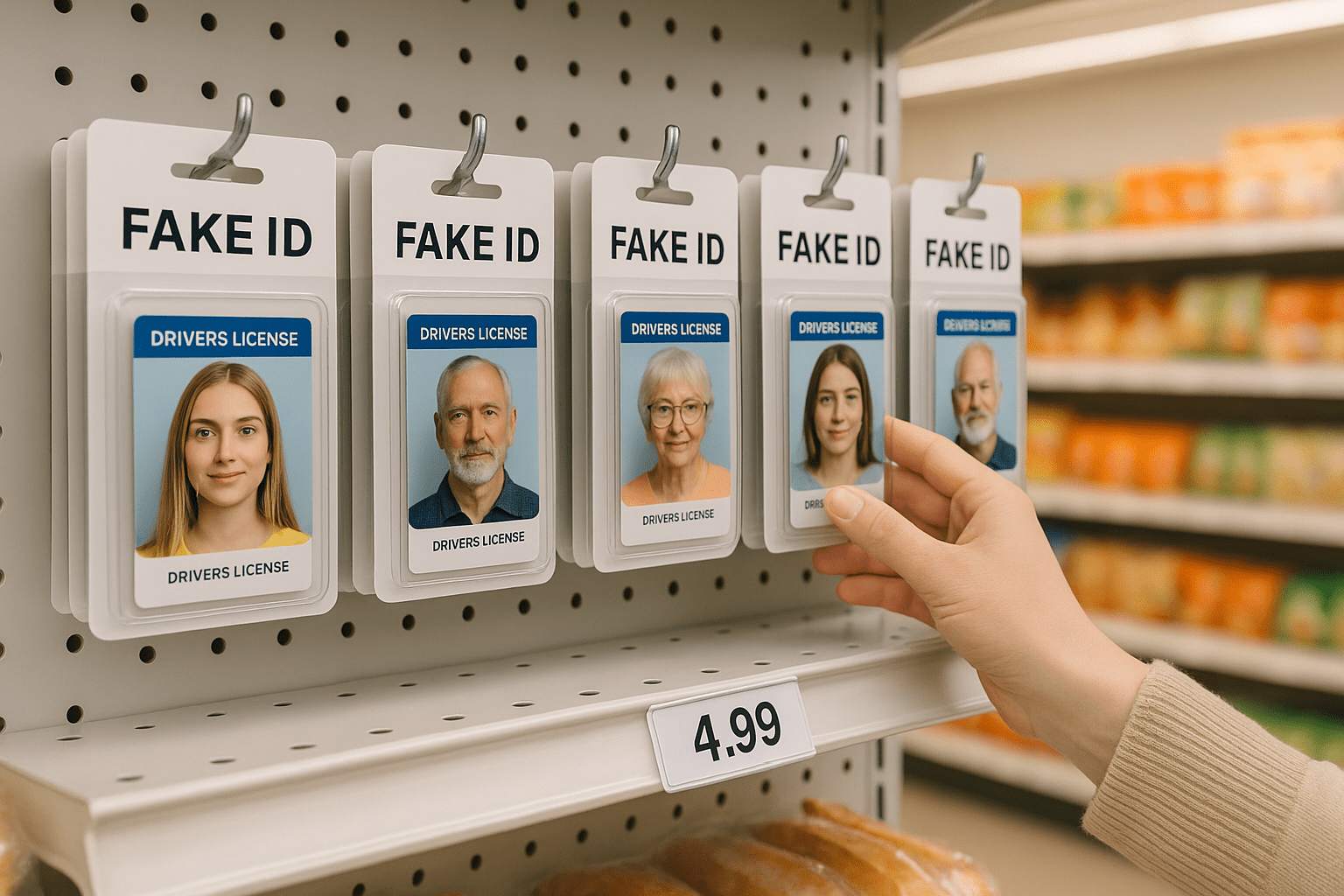
    Need a Fake ID? No problem, it’s easy!

    The identity black market has gone mainstream. Services that churn out fake driver’s licenses, passport cards and “verification” files are cheap, fast and marketed like everyday e-commerce.

    In the last year alone, law enforcement shut down VerifTools, an online marketplace that sold fraudulent identity documents for as little as $9, paid in crypto. In a separate U.S. case, a counterfeiter told investigators he sold state IDs for $250 to people seeking gig-work accounts—showing just how low the entry price is for evading ID checks.


    How easy is it to get a fake ID today?


    Very.
    Counterfeiters operate on open web storefronts, in closed social and messaging groups, and on the dark web – shipping physical cards by mail or delivering digital “packs” instantly. Europol and national police have repeatedly taken down rings that used dark-web listings, instant-messaging apps and postal services to distribute counterfeit IDs across the EU.

    U.S. border inspectors routinely seize bulk shipments of counterfeit licenses at mail facilities, thousands at a time (illustrating industrial-scale supply). And in 2024–2025, European raids dismantled multiple document labs and distribution hubs (including one disguised as a travel agency in Athens), with thousands of forged documents recovered.


    What are fake IDs being used for?


    1) Employment and gig onboarding

    • Right-to-Work evasion and “job identity” fraud (including digital checks). UK verifiers report UK/Irish documents are the most commonly faked in these flows.
    • Gig platform abuse: a 2025 federal case alleges fake IDs were produced and sold to create or pass driver accounts on a major delivery app.

    2) KYC/financial access

    • Regulators warned banks about counterfeit U.S. passport cards used to commit identity theft and open/operate accounts.
    • Global watchdogs note document fraud’s role in enabling money muling and cross-border crime, which depend on “breeder” documents to build synthetic or assumed identities.

    3) Right-to-Rent & access to services

    • The UK raised Right-to-Rent fines significantly in 2024, reflecting the scale of document abuse in housing markets.

    4) Age gates & restricted goods

    • Bars, dispensaries and e-commerce age checks continue to face high volumes of fraudulent IDs; one commercial analysis logged 1,000,000+ fake IDs flagged in a 12-month span across venues.

    5) Immigration and travel fraud

    • Counterfeiters sell green cards and Social Security cards for hundreds of dollars, with recent U.S. convictions underscoring the availability and price point.


    Why this matters: the ripple effects from economies to individuals


    Economic drag & compliance risk.
    Fraud doesn’t end at the first loss. The FBI’s 2024 Internet Crime Report tallied $16+ billion in reported losses (up 33% year over year). That excludes unreported cases and many identity-led schemes. The U.S. FTC separately logged $12.5 billion in consumer fraud losses for 2024, even as the number of reports stayed roughly flat, meaning a higher share of victims are losing money.

    For businesses, every dollar of fraud triggers multiple dollars in operational, chargeback, recovery, remediation and compliance costs. Current benchmarks show financial firms and merchants losing $3–$5+ for every $1 of fraud, depending on sector.


    Public safety & organized crime.
    EU agencies call document fraud a key enabler for migrant smuggling, trafficking and other cross-border crime. Europol’s recent actions in Greece illustrate the scale and sophistication: print shops, distribution hubs and thousands of forged IDs serving illicit networks.


    People get hurt.
    Identity theft drains savings and damages credit; FinCEN and the FBI have warned that criminals now pair fake documents with AI-generated media to bypass verification and manipulate victims.


    The “easy button” problem: speed, price, and scale

    When a usable fake costs $9–$250 and can be delivered in minutes (then reused across employers, platforms and banks) the attack surface grows exponentially. Recent seizures and takedowns show low prices, quick delivery and industrial production are the rule, not the exception.


    What resilient screening looks like in 2025


    High-fidelity document checks, plus:

    • Document forensics: security-feature inspection (microprint, UV/IR, OVD), template libraries, MRZ/1D/2D barcode verification, and tamper detection for screenshots/printed photos. (FinCEN’s passport-card alert is a reminder that “looks real” isn’t enough.)
    • Biometric binding: selfie liveness with challenge-response; texture/reflectance analysis to catch screens/deepfakes. (Regulators flag rising deepfake-assisted document fraud specifically targeting onboarding.)
    • Data corroboration: authoritative databases (work authorization/right-to-work, sanctions/PEP), address and phone tenure, device fingerprint, risk signals.
    • Contextual trust: velocity, geolocation consistency, repeated photo/ID reuse across accounts, known mule patterns.
    • Human escalation with the right evidence: clear audit trails (who, what, when), second-factor re-verification for sensitive roles.

    Bottom line: when fake identities are this cheap and this fast, layered verification is the only sustainable defense.