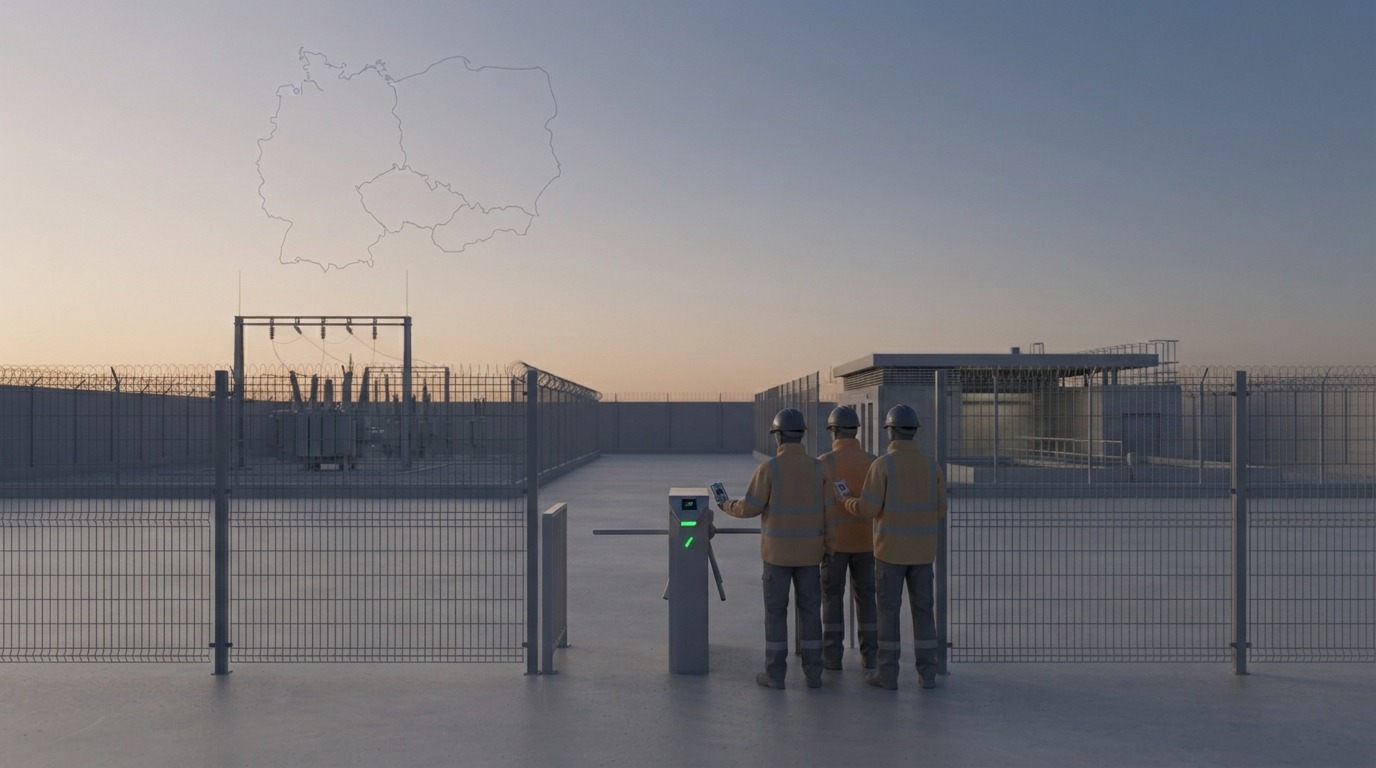
Short answer: the EU CER directive (2022/2557) lets critical entities request identity and criminal-record checks on people in sensitive roles or with access to their premises, information or control systems, including candidates for those roles (Article 14). Czechia (ZKI, § 17), Slovakia (Act 367/2024, § 12 and § 10) and Germany (KRITIS-Dachgesetz, § 13) each turn that into something different. All three reach beyond your own employees to the external staff and suppliers who have access.
What CER Article 14 says
Directive (EU) 2022/2557 on the resilience of critical entities was adopted on 14 December 2022 and replaced the 2008 directive on European critical infrastructure. Member States had to transpose it by 17 October 2024, and by 17 July 2026 they had to identify their critical entities (Article 6(1)).
Article 14 deals with background checks. Member States specify the conditions under which a critical entity may, in duly reasoned cases, request a background check on a person who:
- holds a sensitive role in or for the benefit of the critical entity,
- is authorised to access its premises, information or control systems directly or remotely, or
- is being considered for recruitment to one of those positions.
The checks must be proportionate and strictly limited to what is necessary. At a minimum they confirm the person’s identity and check criminal records for offences relevant to the position, using ECRIS for records held in other Member States. Central authorities must reply to such requests within 10 working days.
At EU level, Article 14 is permissive: it allows checks. The duties come from national law, and that is where the three countries differ.
Czechia, Slovakia and Germany side by side
| Czechia | Slovakia | Germany | |
|---|---|---|---|
| Law | Act 266/2025 Sb. on the resilience of critical infrastructure entities (ZKI) | Act 367/2024 Z.z. on critical infrastructure | KRITIS-Dachgesetz (KRITISDachG) |
| In force | 19 August 2025 | 1 January 2025 | 17 March 2026. Operator duties start after registration, which depends on an ordinance still in preparation |
| Key provision | § 17 | § 12(3) and § 10(1)(e) | § 13(3) no. 5 |
| Who | Workers involved in providing the essential service, and anyone entrusted with direct or remote access. The reliability check also covers job applicants | People who perform essential tasks for the critical entity and are granted direct or remote access to its premises, critical infrastructure, restricted information or control systems | Employees, including the staff of external service providers |
| What | Proof of identity and a clean record through a criminal-record extract, plus equivalent documents from the country of citizenship (for non-Czech citizens) and from any country where the person stayed more than three months in a row in the last three years | Proof of identity and a clean record (no final conviction for an intentional crime that has not been expunged), shown before access is granted, with an extract no older than three months | Appropriate security management for staff, listed as a possible resilience measure |
| Note | Applies once the entity is designated | The security plan must name the categories of people, employees and external workers, who must prove identity and a clean record. The checks do not apply to critical entities in the digital infrastructure and finance sectors (§ 19(3)) | A list of possible measures, not an explicit background-check duty |
Czechia
The Critical Infrastructure Act is the most specific of the three. A designated entity must check the reliability of its workers, including people applying for a job (§ 17(1)). It must require proof of identity and a clean record through a criminal-record extract from workers involved in the essential service and from anyone entrusted with direct or remote access (§ 17(2)(a)). The obligations apply from the day the entity receives its listing decision (§ 11(6)). The implementing government regulation, 127/2026 Sb., took effect on 18 July 2026. For more detail, see what the ZKI requires and our NIS2 and ZKI deadlines.
Slovakia
Under Act 367/2024, a person who performs essential tasks for a critical entity and is granted direct or remote access must prove their identity and a clean record before that access starts. The entity’s security plan has to cover employees and external workers, and set out which categories of people must provide that proof.
Germany
The KRITIS-Dachgesetz lists resilience measures an operator can take. One of them is appropriate security management for employees, including the staff of external service providers. It does not name specific checks, so each operator decides what appropriate means for its risk. The duties don’t apply yet: operators register once the ordinance defining critical facilities is in force, which the Federal Office of Civil Protection and Disaster Assistance (BBK) says is still in preparation, and resilience measures apply from nine or ten months after registration.
What the three have in common: external staff
None of the three stops at your payroll. Czechia and Slovakia tie the checks to access, whoever employs the person. Germany names the staff of external service providers. For an operator, that means contractors, maintenance crews, IT service providers and supplier staff with access are part of the same question: who are they?
For a supplier, it means your customer may soon ask you to prove that your people with access have been checked.
Why suppliers are targets
Suppliers and engineering firms hold information that hostile states want. Two public reports show it:
- July 2024. The FBI, NSA, CISA, the UK’s NCSC, South Korea’s NIS and partner agencies published joint advisory AA24-207A. It says North Korea’s Andariel group primarily targets defence, aerospace, nuclear and engineering entities for sensitive and classified technical information. Its main way in was exploiting known software vulnerabilities, not hiring.
- October 2025. ESET reported that North Korea’s Lazarus group targeted three companies in the defence sector in Central and Southeastern Europe, some of them in drones. Initial access came through social engineering with fake job offers, part of a campaign known as Operation DreamJob.
Two points to be clear about. Background checks don’t stop malware: they answer who has access. And a defence supplier is not automatically a critical entity under CER. The laws above apply to designated entities and the people with access to them.
What to check for staff and contractors with access
- Map the access. List everyone with direct or remote access to premises, information or control systems: employees, contractors and supplier staff.
- Verify identity first. Check the identity document against the person before anything else.
- Criminal records from every relevant country. A record is held where the person is a national and where they have lived, not only in your country.
- Check before access starts. Slovakia requires it explicitly, and Czechia covers job applicants.
- Keep it proportionate. Check the roles that have access, at the depth the role needs.
- Keep the evidence. Record who was checked, when, against which sources and with what result, so you can show it to an auditor or a customer.
- Watch the dates. Extracts age. In Slovakia the extract must be no older than three months when it is presented.
How Scaut fits in
Scaut runs identity verification and criminal-record checks across the EU, with the documentation and audit trail each check produces. Operators can invite their suppliers to screen their own staff and see the status and outcome of each screening, so the evidence chain reaches the subcontractor. See screening for critical infrastructure, or talk to us about your setup.
FAQ
Does CER itself require background checks?
No. Article 14 allows critical entities to request them under conditions each Member State sets. The obligations come from national law, such as § 17 of the Czech ZKI or § 12 of the Slovak Act 367/2024.
Is my supplier in scope?
It depends on access. In Czechia and Slovakia, the checks follow direct or remote access, whoever employs the person. In Germany, the security management measure names the staff of external service providers.
Are defence firms critical entities?
Not automatically. CER applies to the sectors listed in its annex, and defence is not one of them. Whether a company is a critical entity depends on its national designation.
Which countries’ criminal records do I need?
The ones relevant to the person: their country of nationality and the countries where they have lived. Records stay in each country’s own register, and CER points to ECRIS for records held in other Member States.
Further reading
- NIS2 and ZKI: when background screening became a legal obligation
- The Clock Is Running: NIS2 and ZKI Deadlines for 2026 and 2027
- Fake candidates and fake recruiters: hiring after Binance
Sources
- Directive (EU) 2022/2557 (CER), Articles 6 and 14: EUR-Lex
- Czechia, Act 266/2025 Sb.: zakonyprolidi.cz
- Slovakia, Act 367/2024 Z.z.: slov-lex.sk
- Germany, KRITIS-Dachgesetz § 13: gesetze-im-internet.de; BGBl. 2026 I Nr. 66: recht.bund.de
- CISA and partners, advisory AA24-207A, 25 July 2024: cisa.gov
- ESET, 23 October 2025: eset.com